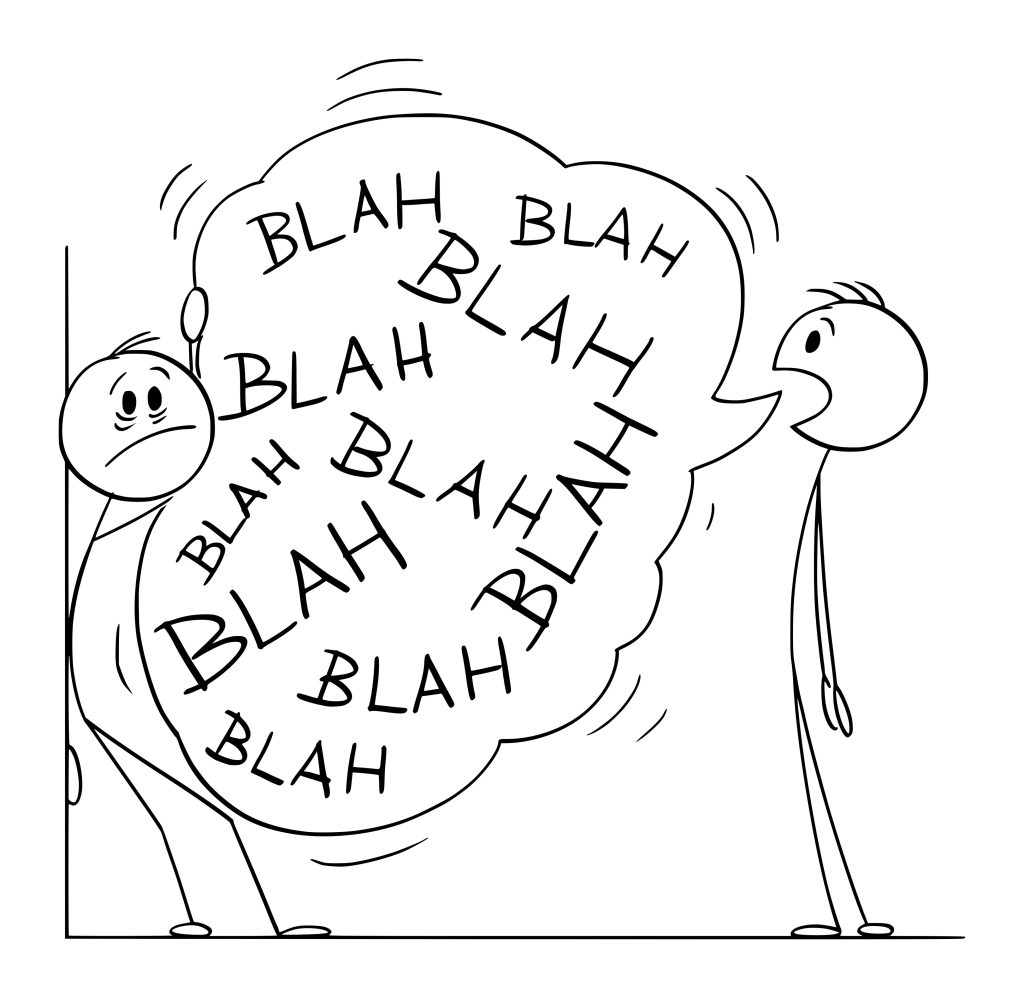
Dunning-Kruger Effect
“I Know What I’m Talking About” (not)
For those who have read many of my past offerings you know I am fascinated by human behavior. My main subject of study is myself as I analyze my own character traits, but my observations of the population in general also act as a kind of human petri dish. A number of years ago I read a reference to the Dunning-Kruger Effect and immediately realized this trait can be applied to every person I know, including myself.
Basically the Dunning-Kruger effect suggests there is propensity for us to erroneously believe we have greater knowledge of a specific subject than we actually have. That we might pontificate about an issue where we have only limited knowledge, making assumptions about that subject. I recognize that this is more prevalent in some people than in others, but I also believe it is something that we all do unconsciously, even if it is in limited amounts.
The definition is exemplified by one of my favorite quotes which is from former Secretary of Defense, Donald Rumsfeld when he said, “There are known knowns, things we know that we know; and there are known unknowns, things that we know we don't know. But there are also unknown unknowns, things we do not know we don't know.” To me he nailed the basic understanding of the Dunning-Kruger Effect, though I don’t believe he intended to be my poster child for its definition. But I will say that Secretary Rumsfeld was at least being honest about his non-understanding of the then current conflict in Iraq.
In using an assumptive and delusional view of the world, I believe we are doing an injustice to both our interaction with our environment and with each other. When we believe we know more than we do, our capacity to learn and grow diminishes. For instance if I believe that I’m really good at picking winners in the stock market and have a sense that I’ve got a great handle on how it all functions, I’m setting myself up for a major financial disaster. If I were to suddenly be wildly successful at trading stocks, it would be mostly due to dumb luck rather than some kind of expertise.
And, if I were lucky enough to be monetarily successful, that success would only reinforce my belief that I know more than most people in picking stocks and so I would continue to gamble until I fell flat on my face. Even then chances are that I wouldn’t take responsibility for the downturn. I would probably convince myself that the spate of ill-timed trades was someone else’s fault.
With regard to a more serious subject, I suspect most of us have overheard someone blathering on about how humans have no culpability in impacting global temperature increases. They will offer their “educated” opinion, most likely gleaned from a biased right-wing media outlet funded by corporations more interested in garnering greater and greater wealth than taking care of our fragile environment. These folks will incorporate various skewed talking points into their discussions about this subject, posturing as if they have mountains of information and experience when, in reality, they have almost zero facts on which to base their opinions. This scenario represents the ultimate example of the Dunning-Kruger Effect.
As mentioned above, I believe we all pontificate about issues or situations where we masquerade that we know more than we do about, at least to a degree. The only way to decrease this behavioral trait is to know we can be (and often are) wrong. And when we suspect that we’ve said or done something incorrectly, we have to examine our belief thoroughly and come to a greater understanding of what is closest to actual fact, rather than subjective nonsense.
Alas we are only human and most people have a tremendous aversion to being wrong, therefore an inability to admit they are incorrect. This was discussed last year in the post titled Agnoscerraphobia. This tendency is not relegated to those of lower intelligence but is found across the board in all echelons of cognitive ability. The thing that links people who are consistently expressing aspects of the Dunning-Kruger Effect is they more likely to have lower self-esteem, hence needing to puff themselves up in social situations.
I go back to my propensity to indulge in a bit of puffery based on my own uncertainty about myself (see PONCI). I want to believe I have interesting tidbits of information, nuggets of knowledge that will allow others to nod their heads in agreement, regardless of the veracity of my statements. I might even be able to convince myself that I know “stuff” about a subject when in reality I know next to nothing. Once again, this is where mindfulness comes in to play. To stop and think about what we are about to say before pretending to have facts about an issue where we know next to nothing is another aspect of being mindful.
And then we should listen. We would be able to learn from those who actually do know a subject, whereas if we fool ourselves into believing we already know that information, we won’t be able to hear the truth. Isn’t that what most of us would like to know: The Truth? Or at least that’s what I would like to believe.
Tobin as usual you do not shy away from controversy. I’ll be the first to jump in, and I hope that others will be provoked to respond and react to your comments on the Dunning-Kruger Effect.
Your comments highlight the proclivity to extend a paradigm of knowledge to exceed the boundaries within which it is fruitful. Aristotle’s theory of knowledge, and the method he implies for functioning works well enough in a pre-industrial society, one characterized by muscle power and hand tools. However, the time honored paradigm necessarily was superseded by Francis Bacon’s pioneering of the scientific method which utilized inductive reasoning and a sceptical methodology. The paradigm has been further modified, the result of cumulative knowledge, and now we have the mind-bending insights of quantum mechanics.
In my opinion the history of science shows that paradigms – frameworks for identifying facts are effective only within boundaries. When we push a belief, a framework which is customary beyond it’s native environment, – then we talk nonsense. The math no longer works either, if one is a scientist…
To state my point a bit differently, belief, enframing is essential, otherwise we would not be able to know anything at all. We employ a matrix that anchors our expectations. Within that zone of understanding, reason is able to make reliable conclusions. I sometimes think these paradigms are metaphors of a sort, especially for language enabled mammals, such as ourselves. We often describe the framework that is used by discursive language. “When walking in the high desert, do not step into brush, to avoid snake bite.” For physics the description could be expressed by high level math. Certainly all mammals use models as knowledge framing that is appropriate for the survival/thriving of their species.
It is ironic that Rumsfeld articulated the conundrum of knowledge, how slippery the slope to playing the fool. He ought to know after his role in devastating Iraq and Afghanistan. (You couldn’t point to a better example than Rumsfeld of the consequence of life in the elitist bubble.) This occurs over and over. The over-reach seems a particular American proclivity. Perhaps I am just more familiar with misfiring policies, the massive waste of effort and money of those settled comfortably in Washington.
Your angle on the prevalence of the Dunning-Kruger Effect points to damaged, or immature egos which cannot abide the shame/guilt which they incur from others if it comes to light a wrong decision was made. Good point. This causes me to suggest two further questions. Why the feeling of shame if a decision made in good faith turns out to be a mistake? Our mistakes are our best teachers. We can be better prepared when similar problems arise in the future. The second question: given the infinity of potential knowledge, shouldn’t every one of us admit that he/she knows next to nothing?
That makes good sense to me!
Keep the good words coming.
Without the gift of stimulation that you and others offer, – life would be monochrome indeed.