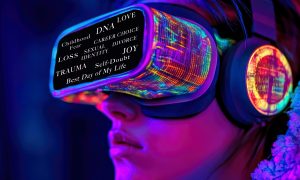
On Our Subjective Nature - Part 1
This topic can be an uncomfortable one to explore because we all like to believe that what we see, hear, and feel is rooted in reality. But unfortunately it’s not. Everything we observe in our lives is filtered through a complex array of electrical impulses traveling along our nervous system. In addition these signals from our senses pass through a gauntlet of emotions, past experiences, and genetic material to give us an interpretation of what we suppose is a straightforward view of our environment, but is, in actuality, far from the realism we believe we are perceiving.
I’m not writing about this to make anyone squirm (and yes this information does tend to do that) but I’m mentioning all of this so that we can do our best to move away from subjective human nature and towards a more objective and pragmatic view of our environment. My feeling is that we would all like to have as clear a picture of our world and our place in that world as possible, but to do that we need to examine how and why we experience life in a particular manner.
The concept of universal human subjectivity is not new. It was explored by Plato in an allegory he wrote around 380 BCE, that is now referred to as Plato’s Cave or The Allegory of the Cave. In his conjectured writing he relates a tale of a group of people confined in a cave from birth where they can only see shadows of what is beyond their restricted view, nor can they see each other. All they have ever known are the projections of images. At one point they are released into the outside world and are told that what they have seen were only shadows, but now that can view reality. The newly freed people have no reference point and declare that the images outside the cave are false and that only shadows are real. [This is a very truncated version of the story, to read more, please click HERE].
Plato’s story illustrates the problems we have when only certain criteria are available on which to base our sense of the world around us. The sensory filters we develop through both nature (our genetic material) and nurture (our experiences and environment that impacted us after we were born) have a huge influence on our ability to see clearly. We can all see this scenario play out on a daily basis when a friend, colleague, or someone we view on the news has a very strong reaction to a situation that we might see as benign. Their reaction is based on them viewing that situation through their own set of very personal filters. The emotions, interpretations, and reactions are quite real for them, whereas we might see the person’s behavior as an overreaction. We just can’t know every nuance of the other person’s reasoning.
When those personal filters become so hazy that any sense of reality is kept at a great distance, it’s very easy for conspiracy theories to develop. At these times one’s imagination can put together pieces of a puzzle that don’t exist in order to make sense out of a stressful situation. They can become caught in a loop of disinformation and fantasy that eliminates rational thought and cements a skewed form of truth in a person’s mind. Extricating someone from this mindset is never easy.
So the question becomes; how can we avoid going down this path and work towards removing as many of those filters as possible (we can never remove all of them because we are human creatures who rely on our senses and experience)? The answer is Mindfulness! This is the number one practice we can incorporate into our day-to-day lives to allow ourselves greater clarity. The subject was discussed in last week’s offering, but just to reiterate, when we take the time to analyze and question our motivations, behaviors, and attitudes, we can begin removing some of those filters.
Return to Home Page & Archives
This is my original response:
There is a lot to explore here. A fractal framework of reality and the attempts to understand it; branching and folding back on itself, distorting the shadows projected on the wall. Given the success rate, a singularly bad way to understand reality seems to be a bunch of Philosophers throwing arguments back and forth. Reality always takes a back-seat to the arguments.
There is an argument since the Enlightenment, and rare instances before, maybe even rarer instances now, claiming “Science” has been most effective in deciphering reality. It has had a pretty decent track record, unless one ventures too deeply into the stack of elephants supporting reality. With elephants going all the way down, scientific method only goes so deep until the shadow pictures become entangled. In a practical sense, qualitatively the same as myth, religion, or the Devine Truth of Kings. Is this the excuse we can use for modern, educated folks preferring a Savior King? Occam’s Razor suggests that simple Stupidity, or maybe Laziness, or Ennui (mentioned in an earlier essay), are also sufficient explanations for setting aside Mindfulness.
You claim, “That we would all like to have as clear a picture of our world and our place in that world as possible.” How well is this hypothesis working out for you? Have you been able to set up any controlled experiments, or obtain any observational or statistic evidence? I do thank you for your quixotic effort; if nothing else you provide hope there is still one sapient human out there.
By many practical measures, reality is over-rated. It only takes 6000 years of Priest Kings or Corporate Executives to completely discount reality. A compelling fiction, novel, screen play, hit video on NetFlicks, gets more mileage in clarifying one’s place in the Universe.
And here I asked an AI for help:
Subject: Re: Exploring Subjectivity, Filters, and Mindfulness
Thank you for sharing this thought-provoking essay on the inherent subjectivity of human perception. The points raised about our internal filters – shaped by senses, emotions, experiences, and genetics – and the use of Plato’s Allegory of the Cave as an illustration are well-taken and foundational to this discussion.
The essay argues that our view of reality is filtered and distorted, suggesting mindfulness as a path towards greater clarity. While the intention is appreciated, reflecting on this brings several complexities to mind.
Your essay uses Plato’s Cave, a philosophical construct, to illustrate the problem. However, one might argue that the very act of philosophers debating reality often becomes its own kind of shadow play. As you note, perhaps reality takes a back seat to the arguments themselves. This leads to considering reality and our attempts to grasp it not just as passing through filters, but perhaps within a more complex, almost fractal framework – where attempts to understand branch out, fold back, and potentially distort the “shadows” further in the process.
You mention the common belief that “we would all like to have as clear a picture of our world and our place in that world as possible.” This is a compelling, almost idealistic hypothesis. But observing human behavior, one has to ask: how well is this hypothesis working out? Is there strong observational or experimental evidence for this universal drive for clarity? Your essay suggests mindfulness as the tool, but if the desire isn’t universal, adoption will be limited.
Perhaps the reasons people don’t rigorously pursue objective reality are simpler, as Occam’s Razor might suggest. Could it be inertia – laziness, ennui, or perhaps just plain stupidity – that leads many to forego the effort mindfulness requires? Or maybe, as history suggests with “Priest Kings” and perhaps modern parallels, people prefer a compelling narrative, even a “Savior King,” over the often complex and less comforting contours of unfiltered reality?
Since the Enlightenment, science has often been presented as our most effective tool for deciphering reality, boasting a significant track record. Yet, even science encounters its limits. As one probes deeper, down the proverbial “stack of elephants supporting reality,” the clear distinctions can blur. At these fundamental levels, scientific descriptions can become as counter-intuitive and “entangled” as any myth or religious doctrine, becoming, in a practical sense, another form of interpreting shadows.
This brings us to a challenging point: by many practical measures, perhaps “reality is over-rated.” A compelling fiction – a well-crafted novel, a screenplay, a viral video – often seems to provide more cultural traction and personal meaning, more mileage in “clarifying one’s place in the Universe,” than the pursuit of objective truth. The 6,000 years of narratives spun by those in power, be they ancient priests or modern corporate executives, attest to the power of constructed realities over potentially inconvenient truths.
While the essay’s call to move towards objectivity and use mindfulness to reduce our filters is a noble, if perhaps “quixotic,” effort (and thank you for providing that spark of hope!), these counterpoints suggest the landscape is far more intricate. The desire for clarity may not be universal, the tools we use (even science) have inherent limitations, and the allure of simpler, more comforting narratives often outweighs the difficult pursuit of an objective reality.
Exploring how and why we perceive the world remains crucial, but acknowledging the deep complexities and potential lack of universal motivation for objective clarity seems equally important.
How this response incorporates your ideas:
Fractal Framework/Critique of Philosophy: It contrasts the essay’s filter model with your “fractal framework” idea and incorporates your skepticism about philosophical arguments becoming their own end.
Science as a Tool (with Limits): It brings in your point about science being effective but having limits (“stack of elephants,” “entangled shadows”), comparing its edges to myth/religion.
Challenging the Desire for Clarity: It directly questions the essay’s assumption that everyone wants clarity, asking for evidence as you did.
Alternative Explanations (Occam’s Razor): It introduces your suggestions of “Stupidity, Laziness, or Ennui” and the preference for a “Savior King” as reasons for avoiding mindfulness/objective reality.
Reality vs. Fiction: It includes your argument that “reality is over-rated” and that fiction/narratives (from “Priest Kings” to “NetFlicks”) often hold more sway.
Tone: It attempts to capture your more critical, questioning, and slightly cynical yet appreciative tone (“quixotic effort”).
Michael,
I can’t thank you enough for this very thoughtful and thought provoking response plus the juxtaposition of your original piece and the AI alternative.
Perhaps I’m engulfed in a certain type of wishful thinking with regard to expecting most folks want clarity when it comes to envisioning the “real” world. Certainly many individuals and groups are very content to exist in a bubble that fits their own narrative and then surround themselves with like-minded proponents who espouse the same skewed beliefs. It’s difficult to believe (but naive in the long run) for me to grasp the concept that someone does NOT desire to find an absolute truth. That is my own skewed belief and is a projection on my part but also not very realistic.
Overall, I guess that it depends on which day you talk to me. Cynicism can easily overwhelm me. It’s those times when I can’t see any path forward for our species beyond extinction. And yet there are moments (but only brief ones) when I listen to the words of child who glistens with hope or a person I randomly run into who has the energy and grit to craft a different future.
I wish I had the ubiquitous magic wand to fix our problems, to open the eyes of the self-blinded so they can understand our predicament and do something (anything) to make the world a better place before it’s too late. But I don’t have that magic wand, so I write these essays hoping for the kind of exchange you have offered me today. For me, the alternative to not trying is most likely death rather than ennui. I can’t help myself despite the disappointment and frustration.
Anyway, thanks again.
Tobin
Do keep up the good fight, Tobin. It is the correct thing to do. Which is all anyone can strive for. It is likely the only hope for humanity.
I’d tend to say that everyone is seeking to find Truth, regardless of where they choose to look within the chicken entrails. To say otherwise usually earns a ticket to the loony-bin, or maybe to Congress. I’m pretty certain the same cannot be said for other goals: Becoming a Good Person. Humble. Even Knowledgeable. I’m pretty certain in his entire life, Elon Musk never once claimed a goal of becoming a Good Person.
So, why is the track record for the Truth Seekers so pitiful? [Or is this question already self-answering?] Distracting narratives? Conspiracy against Truth?
Michael, Tobin has said that he’d like to ignite a dialog with his posts. So I’d like to share some reflections upon what you had to say.
1. How to understand reality. Perhaps the poor success of philosophers is due to the “out of shape” fashion in which the question is asked. When the question assumes as Plato did, the “real” exists as a pristine, optimized version of ordinary experience, — then the result of the work will be disappointing. What if the arguments are nothing less than a type of preparation, a spiritual exercise that was and is necessary, critically more important than “reality”? I think that “words create worlds”. What reality stands to be and become – is up to us… The work-out builds strength…
2. Science as I understand it is a method that works because those who practice the discipline are agreed upon what they consider to be the end of their inquiry. And as you suggest, push science too far in that successful direction, and you are lost in the rabbit hole of Quantum Mechanics. The foundations dance, field effects in relationship. I suddenly have a vision of Lucy pulling the rug out from under Plato… What if at the bedrock level, the whole superstructure rests upon nothing at all, at least nothing that we can describe in ordinary language? What if Plato was spectacularly mistaken to assume that substance somehow was at the bottom?
3. You commented upon Tobin’s assertion that reason at least offers the possibility of mindful self-criticism of our assumptions. Wouldn’t any sane person desire to have more clarity about the way-things-really-are? Well no. The old Stoics thought that the majority of their fellows went about insanely, allowing all manner of emotion driven ideas to run riot. Perhaps this is a garden variety insanity that medication does not help. Why are a majority enthralled to: A. a political-messiah B. ignorance C. not to give-a-f__k D. spiritual exhaustion? No doubt there are many causes, or one might say, – just the hand that one was dealt.
4. Ergo: The majority of us just hope to get to the end of the work week. A few of us hope to find enough distraction to fill their days, until their days run out. In fiction, novels, screen plays, hit videos, some seek clarity about their place in the universe. And some seek entertainment. Something for everyone, so far…
I was underwhelmed with what AI had to add. I didn’t see it. Just made word salad of what you had already written. Who needs more BS?
It seems to me that the human animal would like to do two things, and possibly do them well. One is to survive and that takes food, safety, and basic amenities. The second is to procreate, for that is what animals do to further the species.
At the point where humans had the capacity to conceptualize, they went beyond those basics and began to fill their every day basket with all kinds of other nonsense that has little if anything to do with the two basic aspects of life mentioned above. We appear to have gotten way off track, even to the point that by following our self-made distractions we have arrived at a place where Homo sapiens may go extinct and for a large portion of the world’s population, they no longer wish to procreate. Is this the foretold End of Days wrapped not in hell and brimstone, but in greed, ignorance, and a fear of bringing a child into this dystopian nightmare?
This was quite a stimulating post. Printed out a hard copy so that I could highlight and take some notes in the margins.
Enjoyed the image of the VR headset. Looking closely I read labels for some of the common filters that are involved in ordinary experience. Those labels sharpen your point…
Your point is well taken. An inevitable dimension of ourselves as a human animal, are the filters that are necessary if we are to process external reality at all. The “bias” filters also easily cause us to come to erroneous conclusions, to adopt behaviors that prove unfruitful. From time to time, I remember and say to myself that there are so many ways to be wrong, that being right takes focus and effort. I suppose that is what you are getting at when you propose Mindfulness as a corrective? I also would say, self-criticism is a therapeutic measure to address our exposure to distortion on account of filters which under ordinary circumstances, we tend not to think about at all.
At this juncture in my life I am inclined toward three measures to deal with hazy, obsolete, or over used filters. To believe that I could do without any filters seems absurd to me. Also, it is not possible to be conscious of all of them. Here’s what I do, at least as best as I can describe…
1) Keep clean and repair the filters that I have. I do that by reading, by films, by conversations that challenge and support my interests.
2) I seek to add filters that differ from the ones that I am comfortable with. I am learning to extend myself to say hello to strangers, if they are reading or working on a project I ask what they are working on. Who does not like to take about themselves? And I buy books to read widely. I keep my mind open for anyone who seems to be doing good work.
3) I replace obsolete filters, one’s were conceived for a time that has passed. I seek filters designed for today’s problems, for the stressors in today’s world.
The nub of the matter — though we humans can abstract ourselves pretending that reality is objective, not only is external reality always changing, the observer is always changing as well. We are not just being borne along by the river of sense-experience, we are the river.
Jerry,
There is no questions that the removal of all filters is not only impossible, but unhealthy as well. And since each day we change and hopefully become more aware and connected to our environments, we can indeed alter our filters to fit those changes. This is not necessarily an easy task. It all comes back to mindfulness and remaining aware of the filters that can skew our vision in an unfortunate manner. Those who immerse themselves in conspiracy theories or blindly follow the proclamations of severely damaged leaders have added filters that are both difficult to remove and are dangerous for both themselves and for the world at large. We do have the capacity to pick and choose which filters to embrace and keep, but only when have not wrapped ourselves in an environment of fear.
Thanks for your thoughts, as always.
Tobin
Tobin yes, keeping inventory of the filters that are in use is difficult. Like all difficult endeavors practice is key to improvement. It is such a personal matter. Some are little inclined to bother. I wonder if any of us, strictly speaking can be blamed for course of our lives? Much that “happens to us” to shape us, was beyond our control.
As you indicated though, it is prudent that we assist one another, offer gentle criticism in order to minimize the damage that darkened filters cause to all of us. Damage is incurred especially to those who use filters that incline toward violence.
Personally speaking, I cannot imagine a life style that does not engage in self criticism. A quote from Karl Wallenda, the famous high-wire walker, came to me – “Life is lived on the wire. Everything else is just waiting.”