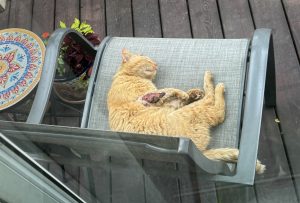
The Feral Cat
I don’t know if the large orange tabby cat who visits our back door ever had an actual home or whether he has always been on his own. What we do know is that for the past few years, Morris as we have named him, has been roaming the neighborhood. Somewhere along the line Morris was injured, either in a massive cat fight or maybe a run in with a potential predator or even with an auto. We do have fox and coyotes in the area, so it could have been any number of possibilities. In the photo above the wound on his leg is quite evident, but we’ve been told by our niece Miriam, who knows about this kind of thing, that he is otherwise doing well and should be left to heal on his own.
The desire to take care of a creature who is seeking help is almost universal within human nature. When an animal who craves either food or attention arrives in our lives through whatever means, most of us have our heartstrings pulled and we will do what we can within our capacity to make a difference. Oddly I have known people who seem to enjoy causing great pain to other people and yet they will go out of their way to help a wounded animal.
What mystifies me is that for many who espouse a certain type of kindness, the quality of mercy ceases when it comes to other people. The desperation of immigrant families attempting to escape a brutal regime is more than evident. Whether they are from El Salvador, Venezuela, Syria, Belarus, or any number of other countries where the importance of human life falls well below lining their own pockets with greater and greater wealth, many American citizens feel it is not worth any effort to help them.
As noted, the immigrants who arrive at our borders are seeking shelter and hoping to find a new life. It is true that quite few of them have entered our country illegally, but even so, we have laws that allow them to apply for asylum or to find work while they attempt to change their status to a green card holder. The vast majority of these people are hardworking, honest, and reputable members of cultures that place great value on integrity. They tend to fill positions that are undesirable for most established citizens such as backbreaking field work, menial labor jobs in the service industry, landscaping, and so on.
Myriad articles have recently quoted Emma Lazurus’s words on our Statue of Liberty. As a reminder they read: “Give Me Your Tired, Your Poor, Your Huddled Masses Yearning to Breathe Free.” Lady Liberty holds her torch out to the world inviting them to find refuge here on our shores. And yet, not only have we closed our doors to those in need, but our current regime in Washington has created a policy to deport millions of those who have already arrived and are yearning to breathe free.
Unfortunately the people who make these policies have no empathy. They cannot imagine what life might be like in the slums of Caracas or to live under the constant threat of either gang or vigilante violence. They view any immigrant (unless they’re white) as less than human and not worth any consideration. These so-called leaders are sociopathic creatures who thrive on brutality and power and the only way to change our nation’s direction is to excise them from their positions.
So we make signs and we march, we read articles about the dysfunction of cruel and unfair policies, we discuss the issues with our like-minded friends, we write, and we shake our collective fists at an unresponsive government. We have a desperate need to believe these actions will make a difference even though we remain uncertain about their effectiveness, but we know we must try.
In the meantime, the orange tabby cat meows at our backdoor hoping for a few morsels of food. We feed Morris when he asks and during the cold winter months, along with some food, we put out a warming bowl filled with water and a heating pad that rests beneath the tarps we use to cover our outdoor furniture. I don’t know if cats can feel gratitude, and if they can’t it really doesn’t matter. But Rachel and I know this little bit of kindness is making a difference in the life of this rough and tumbled kitty.
So, in other words, we must also do what we can on a micro level. Morris is not a family stranded and suffering, caught between cultures; he is a feral cat asking for a bit of kindness. So we will continue to help Morris where we can while we also continue to fight for the humanitarian aid that is critical to those who have done nothing but look to find a better life. It’s what we all must to do save the conscience of humanity.
“Oddly I have known people who seem to enjoy causing great pain to other people and yet they will go out of their way to help a wounded animal”
This is the observation that gnaws at my soul. It truly makes my heart heavy. I know what I’m writing here are common expressions. But now I understand them and feel them as never before. 😢
Georgia – Thank you for your observation. The gap within our species between those of us who can feel empathy and compassion as compared to those who seem to feel nothing but anger encompassed by an overarching desire for retribution is enormous. It’s often difficult to fathom how human beings can co-exist with such a chasm between attributes in our characters. I would like to believe that the vast majority of people, if cured of their various psychological disorders, would opt to be kind, generous, and inclusive, but that may very well be naive on my part. At this point in neurological research, it is difficult to tell how many of these traits are hardwired into our genetic code and how many of these behavioral patterns come from the nurturing side of our childhoods.
Tobin: Thank you for this wonderful essay. IF only we could transfer the kindness we offer animals to human beings. I am so grateful for your wise words. Starts my day on a happier note always.
Thank you Jody. There are times when I post these pieces and I wonder if they are more of an annoyance than meaningful words. Your comments always encourage me to keep going.
Yes, and, our failure to see the humanity in other human beings seems to be a fatal flaw in our species (at least for those that are exhibiting the cruelty we’re talking about). What I find equally disturbing, Morris the feral cat not withstanding, is that beyond the deportation schemes there are other stories getting less attention. The administration is seeking to sell off millions of acres of public lands and opening them up to more and more extractive industries like drilling for oil and gas, logging and mining. This will put millions of animals (as well as people) at risk of extinction and death. So, there is not a lot of empathy for animals in this policy, not to mention the land itself and the degradation that will take place once humans move in for the sake of profit.
Part of the problem is that we don’t really honor the non-human or the human. We see land as capital. We see land as property. We see flora and fauna as expendable when they are in the way of the resources we want. We see those that don’t look like us as not human and also expendable.
We need to write a different story. We need those of us that do have empathy for all living things and for those not born yet to activate hope, to take action, to continue to shake our fists in outrage, to vote, to write, to create and co-create with each other.
And, to feed the feral cats when they are in need.
So well stated, Paul. Thank you! There’s a great deal to unpack with your comments. I sense that many people believe we are given dominion over the land and the creatures of the earth based on biblical scripture. There is also what I feel must be an inherent entitlement in many individuals who are extraordinarily shortsighted in their view of the future.
Another aspect of the human capacity for empathy has to do with the scope of any given situation. People have a much easier time feeling empathy for a single creature than for a large swath of either humans, animals, or land. A great story in Shankar Vedantam’s book, The Hidden Brain discusses a dog left behind on an abandoned freighter and the public outcry to save it. Hundreds of thousands of dollars were spent in to its rescue because people could focus on that specific dog. All the while millions of other pets were ignored because they were part of the mass of the unseen.
A different interpretation of scripture might be that dominion really is intended as stewardship and that, in reality, we have a responsibility to steward each other, the land, the flora and fauna in reciprocity and with compassion so that all may thrive.
While we focus on the one individual sent to El Salvador or the one student detained in Louisiana, to your point about the one dog, we continue to ignore the suffering of millions in refugee situations all over the world.
Scripture and the interpretation of it are one set of stories. It’s time to write different stories.
Tobin this is a relatable story. The presence of avaricious and cruel individuals have been a constant feature of human experience from the very beginning. We’ve seen portraits and read the stories of a few of them during our visit to France.
As your story intimates, asking myself, “What do I want?” And “what am I willing to do now?” are imperative it seems to me.
I mused about several hypothetical scenarios: If someone known to you or me, say a neighbor, made known his intention to trap Morris, for removal from the area – would I raise my voice to object?
To extend that musing in a human direction, if men and women in my town were being captured by ICE without due process, for deportation, – what would I be willing to do about it? If the answer to such questions is affirmative of action, perhaps we ought to begin planning now.
All extremely relevant questions. When do we step in and make our voices heard? When do we place ourselves in harms way to protect friends, neighbors, or even strangers? My answer to those self-queries will probably be the same as yours and I would hope, most of us. That answer is NOW! We have no time to waste.