An Impressionistic POV
Reality vs Creativity
Last week I offered a perspective on our very limited ability to see reality by using René Magritte’s painting, Ceci n’est pas une pipe, to illustrate my thoughts. The essay was about finding a pathway towards what is real as compared to the information filtered by our inherent subjective nature. As I thought more about that quest, I began considering the creative process as a more conscious interpretation of our environment. Whether it is a painting, sculpture, photograph, symphony, ballet, novel, garden, or anything else that expresses a sense of the world by using our imaginations, we all take reality, swirl it around in our minds in order to spit out something that says, “This is how I see life!”
This twist on reality started me considering the old questions: What is Art and Does Art Matter? Almost everyone has gone to a museum or art gallery where they could view a wide variety of artistic expression. For me, there are masterworks that have taken my breath away while in a different part of the same museum I might find bizarre sculptures where I had no clue as to why they were even on public display. In these circumstances I ask myself, “Is it just me that doesn’t get it?” The answer is, no, it’s not just me. But that doesn’t mean another person isn’t gobsmacked by art that seemingly makes no sense to someone else.
Regardless of the end result of any creative endeavor, the fact that a person has a concept of how they perceive reality in a way that others do not is the crux of what art is all about. As a photographer and photography teacher I have had conversations with students and viewers of art about producing work that is considered artistic. Several of those people have declared they do not have a single creative bone in their body. At which point I take an argumentative stance and ask them if they dressed themselves earlier in the day. Their answer is invariably “Yes!” So I explain to them that the very act of dressing oneself, picking out clothes, and adding an accessory or two is very much a creative process. Usually they will say, “Yeah, I guess that’s right.”
In other words, everyone is creative in some manner. And that creativity is an individual’s interpretation of reality, an outlet with regard to a person’s attempt at understanding life. It expresses to others what we see when we take the information that has been filtered through our senses and reinterpret that data in a form that is uniquely ours.
Children in particular are unafraid to paint, draw, and indulge in that self-expression. Their world is new to them and there is a great deal to figure out. Every child has only lived for a limited portion of their life and yet, in that relatively small amount of time, they have learned to map out their confusion, joy, and sadness at being alive. Although it is not a conscious effort on their part, it is usually fairly intense if you have ever watched a child use finger paints.
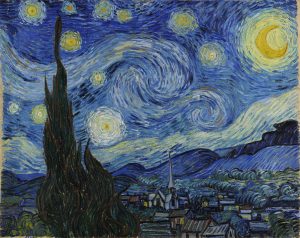
For this week’s image I chose Vincent Van Gogh’s Starry Night. Van Gogh took the treachery and exuberance of life as he felt it and reinterpreted those sensations through the use of his oils, brushes and palette knives. His work is unfiltered in terms of his visions and the expression of his own personal reality. Of course he knew the paintings he produced were not precise replicas of what he saw in front of him, but he did know that he was being true to the information he had absorbed over the years. This raw emotion is one of the reasons his work has never grown old or out of date. He instilled in his paintings the stories of his life with an exquisite aesthetic that digs deep into the person viewing his work.
Ultimately, a balanced life encompasses a combination of reaching towards an objectivity that allows us to embrace science and hopefully communicate with one another in a salient manner (reality) while at the same time being able to express ourselves through a creative reinterpretation of the flawed information we receive through our senses (creativity). This means paying attention to our own behavior, listening to what someone else has to say, assessing those words, and responding in a similar manner, without defensiveness or anger. Internalizing these practices may be our only salvation in the context of this imperfect life. But it is the only life we know or can know. If we develop self-examination as a part of everyday life while remaining as mindful as we possibly can, the potential of making the world a better place is within our grasp.
Ostensibly, at his trial for corrupting the youth of Greece, Socrates said that “An unexamined life is not worth living.” A brilliant observation and something that we should all keep at the forefront of our thoughts when trekking through this all too brief iteration of our time on Earth!
Tobin your post seems a meditation upon “interpretation”.
You mention the imagination. I take the imagination as analogous to a box of crayons, the potential for adding colorful meaning to the black and white page of raw sense experience. You wrote, – “Is it just me that doesn’t get it?” musing about encounter with a sculpture that you failed to make any sense of. Maybe an additional crayon or two for your box would make the difference? Another alternative: what if there is no ‘it’ whatsoever to get? What if all is interpretation? If there were such a thing as a raw, un-colored edition of reality – how would we recognize it?
Van Gogh’s Starry Night is powerful, though I’d not say it is beautiful. The painting is a dream-like expression of the vast emptiness in which we earthlings are enveloped. The painting reminds me that perhaps some of the starlight that stimulates my vision may well come from a star that is now dark and cold. As you suggest art speaks truth which has nothing to do with replicating what our senses tell us.
It seems fitting that your last paragraph is about science. The truth of science is not accomplished by replicating anything either. A hypothesis is conceived, birthed from the imagination, – then a series of inquiries (measurements) are made to find out if the hypothesis is true. Along the journey of experimentation the hypothesis is altered as results indicate, because scientists all agree, that nothing is more important or precious than to find out the truth.
Plato’s account of the trial and death of Socrates is a fascinating tale. How much do we owe the Greeks for our sense of agency, and for freedom of inquiry? Socrates thought that continuous inquiry humanizes us, is worth more than anything else, even if one has to pay with one’s life.
The crux of what I was attempting to get across is that I believe we all seek our own version of truth, of reality. But because those versions are flawed based on our unavoidable subjective nature, each person’s perspective is an individual interpretation of reality. Our imagination is the key to how we take our personal vision and express it to the world. This can be as simple as what we choose to wear or as grand as Antoni Gaudi’s Basilica, both of which are statements of how our inner eye perceives the world around us and how we see ourselves within the context of that world.
In this regard perhaps an interesting analysis would be to ask why some people seek answers through science instead of through the expression of their own reality through a creative process. At first this might seem like an analysis of the difference between apples and oranges or aspects of our curiosity that are on completely different paths and are not really comparable. Yet to me, the internal drive with regard to science and artistic expression seems much the same. Both the scientist and the artist are attempting to discover some semblance of reality utilizing a seed sprouted from the imagination. The end results may differ. A mathematical formula that can be recreated by others is certainly different from a singular cubist portrait by Picasso, but the origins of both are rooted in the reinterpretation of our environment.
I realize this reply is late as another post is due tomorrow.
I am not convinced that the varied personal perceptions of reality are necessarily flawed. Subjectivity as I understand the term has to do with a human subject processing sense experience through the filter of a self that is a product of past experience. It is inevitable that each individual’s version of “world” will be unique in the strong sense of the word. I think that is what we mean by difference, not a flaw.
I believe one of our greatest impediments is our proclivity to see ourselves as flawed, a defect, and worse, to project that judgment of incompleteness, or even evil upon others around us. Perhaps we could say that we are all damaged to greater or lesser degree by the sharp corners of existence. That is no flaw. And better it be expressed with candor…
All of us are in the adventure together!
Ah, language. My use of the word “flawed” is unintentionally incorrect. I believe there is a distinct, actual real world that we cannot access because of our limitations based on the subject nature of our senses and various filters, hence each person has a unique take on what they believe reality to be. I used the term “flawed” because our interpretations of that real world are skewed and so it seems that they must be off the mark with regard to true reality. As noted, aside from some aspects of science, we cannot truly grasp the content of the real world. But to your point, we are who we are. The input we receive from our senses gives us the best view of our environment that is possible within the limitations of the human mind, so your statement that we are indeed, not flawed, (especially in the context of a negative connotation), is a correct observation. But ultimately our scope is limited and we cannot escape the fact that we are subjective creatures living in a world of our own making.