
Mindfulness Part II
Looking in the Mirror
A dumpster full of questions surfaces every time I sit down to write, begging me to answer them before I start another missive about, well, whatever. Invariably my mind searches for a response to those questions I hope to answer within the context of what I write: How do we keep from causing our own extinction? What do I want from other people? Am I snob who writes pejorative essays about fellow humans? What the hell do I want out of life anyway? And what are we having for dinner? Theses are but a few of the things that come to mind at this moment.
All valid questions, all impossible to answer, for Truth is elusive (click for earlier post). It changes with the wind and when at last we think we’ve pinned it down, it recreates itself and becomes a wholly new question with a temporary new answer. Even something as mundane as what we might want to eat for dinner. Yes, this is only sort of a tongue and cheek, but not really. This has to do with our subjective nature that swirls about us. Even when we definitively settle on a chicken enchilada with rice and beans, we’ll watch a commercial for mac and cheese and, voila, we’ve switched our decision (or at least our taste for dinner).
Perhaps that’s not the best analogy since absolute truth is rarely associated with items on a menu, but there is a similarity. Everything we see, everything we sense about the world is open to interpretation. We make subjective choices as we drive down the road or when selecting reading material or stepping into a polling booth. All are based on permeable decision-making processes rooted in our perception.
Hmmm! So here’s today’s question: How do we limit our own subjective nature in order to make the world be a better place in the long run? Good question, Tobin!
What I’ve noticed in my 74 years is that most people, including myself, do not like to look into the behavioral mirror of our unconscious mind. We don’t object to an actual mirror so we can preen and polish our exterior image, but when it comes to assessing why and how we do what we do, we almost always come back to acting on whatever “feels” right. George W. Bush used to say he made decisions based on his gut. So perhaps we would not have invaded Iraq if he had chosen mac & cheese over an enchilada the night before sending our troops into harm’s way. Again, only partially satirical.
The decision-making portion of our brain receives overwhelming input, much of which is unconsciously directed to the amygdala, a part of our brain’s limbic system. It is that portion of our brain where instinctual behavior manifests itself and where the emotional center of our mind resides. The amygdala is a powerful presence when we decide to stay and fight or run away or whether, in a smaller sense, to challenge the driver of the car that just cut us off. Furthermore it tells us we are a member of a powerful tribe, whether it is expressed in national patriotism or civic and neighborhood pride. It categorizes the rest of the human population into colors, economic status, education, and even things like what books one reads, or if a person watches science fiction, or perhaps they collect stamps. Thousands of sub-categories are geared towards finding the tribe or tribes that will accept us as a member. All are based on the subjective nature of our own unconscious perception.
Our only way to combat our gut, is by constant vigilance, by looking into the mirror that reflects our unconscious and assessing each of our behavioral choices (click here to read Mindfulness Part I). When the driver cuts us off, taking a step back and understanding that their conduct is not about us personally. It may have been a challenge to a dual, but it was their action, not ours. And we certainly do not need to accept the challenge. There is no upside here.
On a larger scale, when a politician says we need to stay strong and fight the forces of evil, we might feel like saying “YEAH!” “GO GET ‘EM”, which the amygdala loves, but what does it mean? What are the long-term consequences? What is the intended outcome of beating our chests and shouting into the wind? These are the moments when we need to look at ourselves and ask the difficult and self-searching questions. I understand that I’ve made this suggestion dozens of times in various posts, but the extreme importance of Mindfulness cannot be overstated
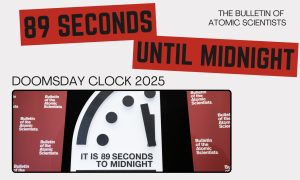
To end this entry, I want to reiterate that I don’t have answers. I wish I did. I wish I could write a few essays about life and solve the problems of the world, but I can’t. Neither can anyone else find all the answers on their own. We are a disparate group of animals, each with a sense of what makes the world tick and yet, as I write this, we somehow have not blown ourselves off the face of the earth. But the Union of Concerned Scientists’ Doomsday Clock is a scant 89 seconds from midnight, so we need to do something, soon. I’m open to suggestions.
Return to Home Page & Archives
Click Here to Add a Comment & Join the Conversation
A quality basket of musings to close out another year. As you observed, somehow the human race has managed to forgo annihilation. So far so good…
Your first paragraph poses several questions that are global in nature. Any and all response answers would be expressions of ideals, interesting but irrelevant to the pragmatic action oriented steps that you are seeking. But, what do I want from others, and what do I want out of life seems dead center of the target to me. As we both know what one desires changes with the passage of time, as the context of one’s life changes. What I seek now is not what I wanted as a 30 or a 40 year old. I am 76 presently.
The conundrum about truth seems paramount, coming up over and over in all cultures when you pay attention to the stories. You touch upon the crux of the matter which old Heraclitus (540 BCE to c. 480 BCE) wrote about. In essence he said that you cannot step into the same river twice… Change, all is change, and of that we are certain! As you note change makes defining Truth very very difficult. I liked your example of deciding what to have for dinner chicken enchilada or mac and cheese… After all the body is where the matter of deciding upon truth begins, the experience of the five senses, and “to settle” is to draw a line, albeit in part arbitrary, between the enchiladas or mac and cheese. Truth is a line that we draw, a boundary of self-creation and world-creation. And the body is the gateway to all decision making.
You touched upon subjectivity, the idiosyncrasy of doing what “feels” right. No doubt the matter begins with a feeling, but “what is right” has to do with culture, the observance of limits that in the past have resulted in the survival and with luck, the thriving of our tribe. And yes, George Bush launched the Second Gulf War on the basis of his gut. I recall that Bush was a recovering alcoholic which amounts to a poor record of impulse control. To Bush the decision “felt right.” I agree with your point that gazing into the dark subterranean passages of our subjectivity is unnerving. Our decision making often easily becomes overwhelmed by monsters never brought into the light of consciousness. The “fight or flight” impulse triggers are as old as when we lived in small groups on the African Savannah. Threat assessment cannot be helped. Nor should it be.
Mindfulness strikes me as a treatment, an amelorative measure rather than a cure. Life is always presenting circumstances which initially strike us as a threat. As you observe many are simply chance, not meant as a direct threat. The driver who cuts us off is a good example. Taking that second look at ourselves in the light of the immediate circumstance is an example of mindfulness. Granted this is difficult. I am not very good at this. But I realize that what is needed is not a final, definitive solution to “everything” that’s out of joint, but a “good enough” tactic for getting from A to B here and now, today.
Tobin, again a quality essay to stimulate thought, self-reflection. That is a gift to all. Keep on writing.
Peace and prosperity to ALL of us in 2026.
Thank you, Jerry, for the wonderful adjunct to my post, as always! I agree that being mindful of our actions is both difficult and not something we Homo sapiens are very adept at. I view the incorporation of mindfulness into every day life as an evolutionary process that we are only beginning to use. I would hope that if our species has the wherewithal to survive our own ignorance, we will continue along the path to great and greater self-awareness with regard to our subconscious motivations and actions. I realize this is asking a great deal from a creature that continues rushing towards self-destruction, but it is the hope of a better world that keeps me alive. Perhaps I’m a doom-sayer or worse, just blatantly naive, yet here we still are, doing what we can.
I got to the end of second paragraph and suddenly realized it was time to feed my horse. Lesson to be learned: if Tobin had not mentioned food my horse would be deprived of her breakfast, not to mention all the other synapses of fate involved. Quantum mechanics or something?? Only The Shadow knows…