On Language
From 1979 until 2009, historian and writer William Safire authored a column in the New York Times Sunday Magazine with the title of On Language. His insights into the origins of words, how their meanings have changed over the years, and the various uses of words and idioms in the modern lexicon were a Sunday morning staple for me. And so understanding how language impacts our daily lives has been a fascinating study of mine for decades.
The importance of language is self-evident since communication between members of our species has been beyond critical in terms of our evolutionary growth. Throughout the vast majority of human history, from our first grunts to a much more complex vocabulary, language was exclusively verbal. The written word, whether symbols or letters, only developed in the last 5,000 years which, in the timeframe of our evolutionary development, is a relatively tiny blip of time. And even then, it is only within the last 200 years that learning to read and write has become a standard for the populations of most cultures.
Regardless of our relatively recent advances in communication, and in particular the use of artificial intelligence based digital translators, succinct discussions across languages remains elusive. Researchers have recognized over 7,100 individual dialects that exist in world cultures today and it is impossible to say how many have been lost over the centuries. The mythology in the Bible suggests the dissemination of people and cultures took place when the population attempted to build a structure to heaven and God then scattered humans giving them all different languages so they couldn’t communicate with one another. My guess is that the Tower of Babel myth may not be historically accurate, but who knows. In this context it should be remembered that our ancient ancestors lived in small nomadic tribes developing their own ways of communicating, especially as the human diaspora spread across the globe and settled in vastly different environments.
What I’m leading up to is the idea that any language is quite flawed. For the sake of clarity in this post, I’ll focus on using the American version of English. Most of us learned to read at a very early age. We grew to recognize words, understanding that Jane, Dick, and Spot could run and jump using illustrated actions accompanied by words that matched those drawings. The actions of the characters were basic and straightforward, so there wasn’t much debate about the nuances of what was going on. But then came other words that were more complex and open to interpretation even though we assumed they had distinct meanings everyone could understand. Not so, as we found out later in life.
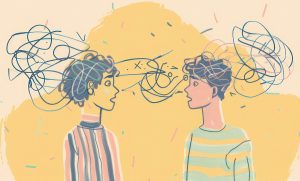
Individual words such as fear, freedom, rights, democracy, patriotism, God, love, tolerance, truth, kindness, etc., come to mind. There are thousands of such words, all of which contain malleable meanings notwithstanding the fact that we have been taught to believe they have specific and defined meanings. What this comes down to is that when we discuss a topic with another person, we use words we believe have universal definitions, however, the other person is interpreting them from their own perspective. Even though it appears on the surface as if we are both speaking English, we are actually speaking two personal languages.
In discussing politics (or any subject that uses many of these malleable words) with someone whose point of view is very different from my own, I do my best to listen, I ask questions, I look for common ground so that we have a starting place for our conversation. But when we begin using the words that seem defined and are, in fact, open to vastly different interpretations, we are bound to become frustrated, angry, and hopelessly at odds with one another. I don’t know how we overcome this disparity in definitions. With specific words we might stop for a moment and spend time delving into our intended use of a certain word, but it’s difficult to imagine a conversation where two people pause every 20 seconds to extract an agreed upon meaning of a disputed word. That scenario might be a good exercise in etymology (the root and meaning of words) but it is ultimately completely unmanageable in a conversation.
A part of the problem is that many of these words are imbued with emotional content. And because emotions contain “feelings” rather than a defined substance, our feelings become entangled in the implied meaning of our words. Once that happens, we’ve pretty much lost the battle of making a clear point that can be understood by another person who is also wrapping a personally defined emotion around their own words.
If our species is able to move forward without self-destructing, perhaps we can find a path towards greater agreement on the basics of communication and the use of language. Scientists have been able to create a more succinct but very esoteric way of communicating. All one has to do is try to read a paper in the New England Journal of Medicine or The Journal of Advanced Physics and unless you have a PhD in either of these specific areas of study, it reads like an alien dialect. For the most part the authors of these papers use obscure words because they are definitive in their meanings to others in their field, so there is little room for misinterpretation.
Meanwhile, the rest of us continue to march along trying our best to talk to our fellow humans in ways where we can relate. Not an easy task, but something that is of the utmost importance for us if we are going to live together in our one and only home.
Return to Home Page & Archives
Click Here to Add a Comment & Join the Conversation
“I am fluent in over six million forms of communication.” – C-3PO
Michael – In that case you will be my “go to” for translating the gobbledygook I hear and read during the course of almost any day.
This is pretty spot on! The generational language gaps become evident when I speak to my child. I am reminded that in what we say, there is a separation in our understanding, due of the interpretation of the definitions of words that shift in time! Language is not static, it evolves. With that being said, we might consider when jumping to conclusions, based on what is linguistically familiar.
Shift happens!
Michal – Thanks for your thoughts on this. Certainly is older folks are lost in translation when listening to Gen Z, X, or Y. If we even attempt to jump into a conversation using terminology we believe is correct, we are looked at as some kind of archaic creature from the Stone Age. The reinterpretation of language is also cultural, economic, spiritual, and political. There are so many ways to use a vast number of words it seems almost fruitless to try. But we have to at least give it a chance. As difficult as it can be at times, stopping in the middle of a conversation to clarify what is meant can go a long way in resolving at least some of the issues.
Many years ago I tried to teach Tobin how to properly hit the nail on the head, but he had such innate ability that even I couldn’t make him miss. Of the things or two I’ve learned from him since then, the third is the most important; that, like words, every person on Earth is mis-understood in many ways or another. Realizing that we are one of them makes humble pie a darn good breakfast.
Ern – Perfect. Thank you !!!
“What I’m leading up to is the idea that any language is quite flawed.”
Language is a tool. Tools have uses which are sometimes rigid, such as design for certain screw-head. You’d be hard pressed to grab that tool for any other use. Others, such as a hammer can be used in many contexts, if you need to apply the shock of force. We begin our language learning project with the simple naming labels that you mentioned. Naming is always an essential aspect of language. Names call to mind things, and experiences of things. Like a photo album.
As philosophers learned in the early 20th century, language cannot be limited to the labels and their relationships, in others words a clean language modeled after mathematics. The idea that legitimate language features transparently clear meaning, would eliminate all reference to our emotional life, as well as our artistic efforts. The movement in philosophy was called Logical Positivism. It failed.
The ultimately important dimensions of life are inherently unclear. A modicum of good will is a requisitefor communication to be understood. I would suggest this is where the problem usually lies. When interlocutors expect to be misunderstood, indeed they become as ships at sea passing unseen on a dark night.
Communication at best is work, often it is hard work. We are subjects, each with a bespoke composite of genetic inheritance and the residue of experience, all of that is a silent penumbra around our use of language. Every subject has the same dilemma,…
Your suggested methodology implies that listening well is the highest of arts. Following that, the ability to conceive relevant questions makes a difference. Finally to actively seek common ground. All sound advice.
Often what you suggest is enough.
But sometimes it isn’t.